HISTORY

The following text was taken from THE ST. BARNABAS CENTENARY BOOK
Researched and written by Carrie Pemberton

Early History of St. Barnabas

The early days of St. Barnabas were passed in unpretentious style in a small Covent Garden cottage, where in 1862 evening services began to be held. This mission outreach down the youthful Mill Road was the responsibility of St. Paul's Church, itself a comparative newcomer to the Cambridge ecclesiastical scene. The district was known as- Sturton Town, served by Sturton Town Hall (now the Kinema opposite the church) and was growing vigorously as streets of artisans' dwellings emerged in the formerly rural part of Barnwell.

The northern end of Cambridge, which was now beginning to change radically, had for many years been amply catered for by the old Parish Church of St. Andrew the Less. The area had, until the late 1840's, consisted entirely of university gardens and fields. The construction of the Great Eastern Railway with its concomitant sheds and station set back from the Mill Road made this portion of Barnwell ripe for housing development. In 1839 the rector of Barnwell the Rev. Perry saw Christ Church opened as a new church to serve the area. This was swiftly followed in 1842 by the opening of the hurriedly built St. Paul's. The Rev. Perry emigrated to become Bishop of Melbourne, but the partitioning of his old parish continued apace, with four more churches being built in the space of 30 years: the Priory Church 1854, St. Matthew's 1866, St. Barnabas 1870, St. Luke's 1874.

In 1867, it was decided to appeal for funds to build a church on the Mill Road. The district was bounded by three churches, St. Paul's, St. Matthew's and Christ Church, but none of these was deemed close enough to serve the emerging population. "More than 400 persons" were report-reported to be living in this ecclesiastical no-mans-land and, with a plan before the Cambridge Council for the construction of 80 more houses, the funding committee's task was urgent. The vision to build St. Barnabas belonged to the Rev. E. H. Hall, then vicar of St. Paul's. He did not lack well-meaning advice to the contrary. "I did not take that advice, and the anxiety connected with the work has not shortened my days, although my hair has grown grey," he told friends later. Initially, a site overlooking Parkers Piece was envisaged for the new church, but the owners of the site offered an alternative location down the Mill Road instead of the expensive land around Parkers Piece.

The generosity and active participation of the university in funding the new city churches was considerable. In the case of St. Barnabas, Gonville and Caius not only donated the site but also provided £1,000 of the £1,200 required to build the first stage of the church. The Rev. Dr. Serle, Vice Chancellor of the University in 1889, reflected on the links made between the churches and the university. "The predominant idea about the university is to encourage religion and church feeling whenever that is possible. Indeed, the churches in the outlying parishes - St. Luke's, St. Matthew's and St. Barnabas' Church - have all been helped in a great measure by the university." The Vice Chancellor noted how tutors had taken time out of busy teaching programmes to consult on building plans, valuable time had been given and money generously donated by many in the university. This was an example of how the university should be vitally participating in Christian work throughout the land, Dr. Serle concluded.

On June 11th 1870, the chancel of St. Barnabas Church, Mill Road, Cambridge was opened by the Rev. E. H. Hall for the purpose of Divine Worship. Less than a year before the Lord Bishop of Ely had lain the foundation stone in a muddy field proffered by Caius College. The Lord Bishop told the congregation assembled at St. Paul's for the service of thanksgiving that they were "met that day to lay in faith the first, the foundation stone of a new church on the Mill Road, to be called after the name of St. Barnabas, the companion and fellow-labourer of St. Paul." The area was expanding rapidly, the Bishop explained, "There are ahead] from 600 to 800 souls, houses are hired as soon as their foundations are laid and in a few years this part will be full of inhabitants." A procession from St. Paul's to the new site followed the service and the Lord Bishop deposited a glass bottle containing a parchment into a cavity in the lower stone.

"The foundation stone of the church dedicated to the holy apostle Barnabas was laid on Wednesday, June 9th 1869 by the Lord Bishop of Ely (the Rt. Rev. Edward Harold Browne), the Vicar of St. Paul's (Rev. Henry Hall) and Churchwardens George Gabriel Stokes (Lucasian Professor) and Philip Hudson. "

"Establish Thou the work of our hands upon us, Yea, the work of our hands establish Thou it."

The reporter for the Cambridge Chronicle in June 1870 attended the opening. "The portion of the church opened on Saturday last is but the chancel to the intended entire building, which is designed to have a vestry on one side and an organ chamber on the other. The style of architecture selected for the building is the third pointed period of the latter part of the thirteenth century, when the Gothic art had reached its acme of perfection in proportion, elaboration and enrichment"!

The chancel seated, extraordinarily enough, 200 regular attenders for morning and evening worship. The seats of the church were free and unappropriated. With the district continuing to expand, however, it soon became obvious that the proposed nave and aisles should now be added to the shell of the church. At that time the architect's plans included a proposed bell-tower (see opposite) to be built in the angle of the north aisle and the chancel, something that was never to materialise. No less a place than the Guildhall was chosen for the launching of the Church Extension Appeal in 1877. In attendance were dignitaries of the university, including the Vice Chancellor (Dr. Atkinson) and two prelates, representing the sees of Ely and Oxford. There was pressure to create a new Ecclesiastical District, or parish, to be served by St. Barnabas, but first the church had to be extended to accommodate its would-be parishoners. It was proposed that the district should be createc] out of parts of Christ Church, St. Paul's and St. Matthew's parishes.

The Bishop of Ely was an enthusiastic supporter of the extension of St. Barnabas. In a sermon at St. Paul's the Bishop declared his colours almost immediately:

"I come to plead with you for the means of completing the new church of St. Barnabas, and so of bringing near the faith of Christ to the new township which is springing up on that side of Cambridge. There is rapidly growing in that neighbourhood a large population which will not connect itself easily and naturally with any existing church. It has moreover a population which from its character has a claim on the whole of Cambridge, for though living in one spot it ministers to and naturally arises out of the necessities of both the University and the town."

At this time the church had a massive Sunday School of some 150 children which was run by undergraduates from the university. One of these committed students was Stanley Peregrine Smith, a member of Trinity College, later to become one of the Cambridge Seven who joined the China Inland Mission under Hudson Taylor's leadership. Plans were under way for the construction of a small building along the side of the church which would serve as a church school and accommodate the Sunday School. St. Barnabas had been sited in the middle of a rapidly developing area. It was a church for artisans, many of the men worked on the railways, other were small shop owners, while many of the university's bedders and servants had their homes and families here. The Rev. Harry Hall (vicar of St. Paul's) reported to the Extension Fund committee that "although the inhabitants belonged chiefly to the artisan class they had formed themselves into a band and undertaken the management of funds."

Opposite the church was the local workhouse, opened in 1838 and now the Mill Road Maternity Hospital*, but the records show little contact between the nascent parish church and its poorest parishioners.

In October 1878 the memorial stone of the nave was laid by the Earl of Hardwicke who reflected that the area was "not what may be called a wealthy district", and congratulated the committee on raising the princely sum of £1,800 to enable building work to proceed on the nave and aisles. By this time the population of the area had catapulted to 2,000 and, as the Earl rightly observed, "the church in which you have met together is not of that size and dimension which is needful for the district". Luncheon for eighty of the ladies and gentlemen present was served in the recently constructed schoolroom following that service.

There was a large gathering of university and Church dignitaries on Tuesday May 4th 1880 to witness the consecration of St. Barnabas' Church. The choir was augmented by choristers from Caius College Chapel and, as the ubiquitous reporter from the Cambridge Chronicle observed, "the harmonium was nicely played by Mr. F. B. Reeve." The Rev. A. P. Woodhouse was curate-in-charge of St. Barnabas at this time. Until 1871, the clergy of St. Paul's had conducted services in their daughter church, but it soon became apparent that a curate-in-charge was required until St. Barnabas became entitled to a vicar of her own. There was to be a stream of curates-in-charge before this came about.

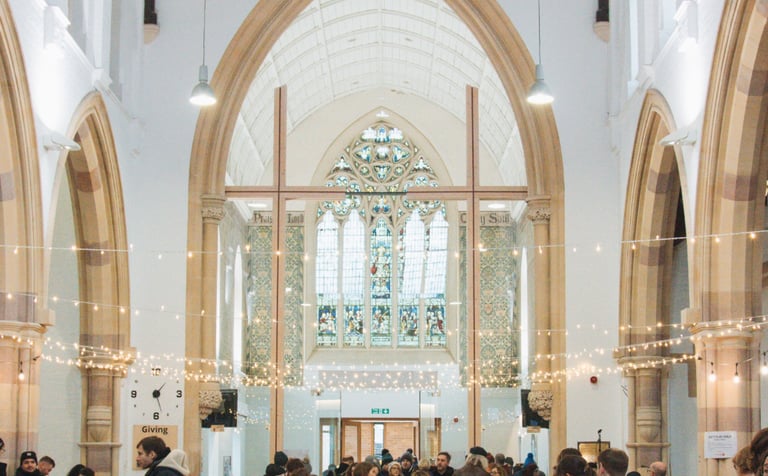
Again a private luncheon in the Guildhall celebrated the consecration of the nave and two side aisles. The walls were of brick with white brick facing on the outside of the church. The windows, string courses, corbel courses and weatherings were in Corsham stone. Praise for hard work and applause for the vision of the committee was loud. The Rev. Harry Hall reminded them of the humble means of many in the district. "One of the very first offerings that was sent to me towards the cost of the erection of the church was sent by an old servant, she enclosed with a letter an offering from her small wages, and it was a sovereign. (Applause) Since that time we have arranged for collections in all parts of the district. The small sums of money that they had gathered from the poor of the district amounted to nearly £200". Nevertheless the bulk of the money which was paying for the establishment of St. Barnabas was coming from outside the parish. Professors Lightfoot, Westcott and Babington were among those senior members of the university who gave generously. Every college in Cambridge gave something towards the building fund, and the Earls of Powis and Devonshire and the Principal of Ridley Hall, the Rev. H. G. C. Moule also donated substantial monetary gifts. Frequent collections were also taken from the older city churches; Little St. Mary's, St. Giles, Great St. Mary's, as well as from St. Barnabas' alma mater St. Paul's.

The building was not yet complete. A vestry, organ-chamber, north porch and further extension to the nave awaited some further push. The church now had a capacity of 350 but it was not the limited space that worried the commentator in the Cambridge Chronicle. "It might be suggested," he said, "That when funds permit some portion of the desolate ground surrounding the church be railed in, laid with turf or soil, and planted. Thus completed, the church and its precincts would help to give a cheerful aspect to what is at present a rather dreary locality of the town."

In February 1886 invitations to attend a meeting on the 16th in the Guildhall with a view to the enlargement of St. Barnabas' Church and the consequent formation of an Ecclesiastical District were distributed among the influential. On the platform that night were the Vice-Chancellor, the Regius Professor of Divinity, the Mayor, the Master of Corpus Christi College, the Rev. H. E. Ryle and other notables. The pressing need was that an Ecclesiastical District should be formed out of parts of St. Paul's, St. Matthew's and Christ Church parishes, so that St. Barnabas could obtain a vicar and operate as a robust parish church in its own right. For this to become a reality the recognition of the Ecclesiastical Commissioners was required, and that would not be forthcoming until the church was capable of accommodating at least 500 people.

Windsor Court was the august venue for the announcement of the new Ecclesiastical District of St. Barnabas, Cambridge, before Her Majesty's Privy Council. The date was the 17th December, 1888. The parish's northern extremity was the junction of Barker's Piece with Parkside, Mill Road, East Road and Gonville Place. It's southern extremity was the railway line, cutting through the workshops of the Great Eastern Railway Company and winding up some 53 chains down the Newmarket Line. This was the portion taken from St. Paul's parish. The remaining area was portioned off from St. Matthew's and St. Andrew the Less.

At a total cost of £5,862, St. Barnabas' Church had at last been structurally completed, only 26 years after the small evening meetings in Covent Garden had begun. Now St. Barnabas was pressing for a vicar and a vicarage, but the rapid growth of housing on the other side of the bridge, in Romsey Town, demanded a different set of priorities. In October 1888, it was decided by St. Barnabas to build a permanent church on the corner of Thoday Street and Mill Road, where there was a temporary wooden church for the purpose of outreach. In June 1880, Professor Babington laid the foundation stone of St. Barnabas' first daughter church and on May Day 1890 the church of St. Philip, Romsey Town, with a seating capacity of 500, was opened and dedicated by Lord Alwyn Compton, Bishop of Ely.

The threefold plan, undertaken by the Rev. F. F. Tracy who had become curate-in-charge in 1885 was nearing completion. The church had been successfully enlarged, there was now a recognised parish of St. Barnabas and the temporary mission hall in Thoday Street had been replaced by the permanent church of St. Philip. In 1888, the curacy was taken over by the Rev. C. Butler who became in February 1889 St. Barnabas' first vicar. This ex-businessman and Pembroke M.A. was released to supervise the building of a vicarage alongside the Infants' School, the land for which had been yet again donated by Gonville and Caius. Meanwhile the new vicar set up temporary residence at 21, Tenison Road, which was to prove his permanent address throughout his incumbency.

In a character portrait carried by the Cambridge Weekly News, following the Rev. Butler's institution, the new vicar was reported to have initially returned to Cambridge in order that "he might find leisure sufficient to qualify in the medical profession", so that he could work in future as a "medical missionary to our colonists in the scattered districts of America" This ambition was thwarted by the demands of the parochial ministry at St. Barnabas. The population of the parish had by now grown to 6,000, the area was generally regarded as a slum, "being very poor and very populous". This did not deter the newcomer. A strong advocate of the Temperance Movement, the Rev. Butler combined this concern with "a strong inherent anxiety to seek the welfare of the working classes and of humanity in general".

The new vicar quickly forged links with his parishioners by the printing and distribution of a monthly parish letter. This set out parish business and included an impressive list of 18 weekly meetings at the church. This was seen by the Weekly News as a "capital medium for reaching those parishioners whom neither the vicar nor his helpers may be able to reach personally". St. Barnabas' dependence on the finance and personnel of the university was now spoken out against. At the welcoming tea held in Sturton Town Hall and attended by over 400 parishioners the Rev. Emery, Archdeacon of the diocese, warned that "they ought not to rely upon the university. Instead they ought to rely upon themselves". The parishioners were exhorted to provide their new vicar with district visitors and parish helpers from amongst themselves and in every way to support with their time and their money the work of the church in the district.

The Rev. Butler never did see the competion of the new vicarage. In September 1892 he was appointed to St. Jude's, Birmingham, after only three years at St. Barnabas, and was replaced by the Rev. T. W. Thomas who was to benefit from the work of his predecessor. In 1894, the vicarage house was finally dedicated and declared ready for habitation The Rev. Thomas who, with his wife and family had been living out of the parish along the Hills Road, declared at the formal ceremony that, "it gives us great joy to be able to come into the centre of St. Barnabas' parish. The Cambridge Chronicle reported that "the vicarage, which has a pleasing approach, consists of white brick with red brick facings. The Vicarage Building Committee, the subscribers and members of the congregation are to be congratulated on the convenient and substantially constructed dwelling that has been erected."

The compliments for the new building abounded as the Rev. H. C. G. Moule (Principal of Ridley) gave a short address in one of the vicarage rooms at the dedication service. Preaching from St. John XII, verses 1 - 3, he observed that:

"One delightful truth shone out of these words, that our Lord was at home in the home. He delighted in the home at Bethany where, they knew, He often resorted. This soon to be developed home, was a place where Jesus Christ could be at home. This dedication of the house to the Lord was the invitation of the Lord into the house. They were led to remember that within those walls all that was sweet and pure and homelike might dwell Might He, by His Grace, Whom they loved and served, make these rooms, as they took on the look of home and familiarity delightful to the occupants with the thousand associations of Christian home life."

Tea and a tour of the residence followed the service.

The building programme was now nearly over. The vicarage had been built at a cost of £2,017 and in 1890 the church organ was successfully reconstructed and placed in the chancel at a cost of £166/10s. In the same year, the mission room operating in Cockburn Street became the Tracy Memorial Hall in memory of the late Rev. F. F. Tracy, for the purpose of mission in St. Philip's. Meanwhile, St. Barnabas had no similar building to accommodate its clubs and associations which included the Sunday Schools, the Young People's Christian Union, seven Bible Classes, the Industrial Class, the Boys' Brigade, the Sowers! Band and Gleaners' Union. This deficiency was soon corrected in 1897 with the opening of the Babington Memorial Institute along the East end of the church.

The Institute was built in memory of the late Professor Babington who had been Professor of Botany for many years at St. John's College and widely respected as "a devout, energetic and deeply earnest Christian', Bishop Henry Perrott Parker, a former student of Trinity College, who had whilst an undergraduate been a superintendant of the church's Sunday School, later to become head of the church in Equatorial Africa, where he was martyred, and finally Jani AUi, who while at Corpus Christi College, had worked with Henry Perrott Parker in the parish and had later returned to Calcutta as a missionary to the Moslem community. All three of these men had been committed to the work of St. Barnabas and had given extensively of themselves to the work of Christ in the area. The site was donated by St. John's College and the hall cost a mere £1,545. This brought the total cost of the building programme to date to £11,395, £10,000 of which had come from outside the parish. It was the year of Queen Victoria's Diamond Jubilee and the parish of St. Barnabas was now the second largest in the Ely diocese.

At last, on November 8th 1906, the bricks and mortar were finally completed. The young men's room at the far end of Covent Garden was opened by the Vice Chancellor of the university, the Rev. E. S. Roberts, Master of Caius College, and this gymnasium, doubling as a drill hall for the Boys' Brigade, was to be the last part of a building programme that had spanned over 37 years.

The incumbency of the Rev. J. W. Thomas (1892 -1907) straddled the turn of the century. In his farewell letter to the parish in July 1907, the retiring vicar noted some of the main changes that had occurred in the district since his arrival. The growth of the area had been prodigious. St. Barnabas Road, Glisson Road, part of Mawson Road, part of Tenison Road, Mackenzie Road, Collier Road, part of Willis Road, a dozen houses on the Mill Road, as well as the Free Library just before the Mill Road bridge had all sprung up over the last 16 years. The church had echoed the area in its formidable building programme. The vicarage, the Babington Memorial Institute, the Young Men's Rooms down Convent Garden had all been built during this time. Improvements within the church had been numerous. Pitch pine pews were slowly replacing the rush chairs in the central aisle, the oak eagle lectern was a gift in this period, and incandescent gas fittings combined with brass umbrella holders were installed down the middle aisle, thus completing the progressively affluent interior. Outside, the hopes of the Cambridge Chronicle columnist were fulfilled by the building of a stone wall with iron railing and gates along the ground fronting the Mill Road.

The change had been radical. "Thirty years ago there was neither church nor chapel, nor many dwellings for men to be seen in this part of Cambridge. The cattle grazed in the meadowland, and golden cornfields spread themselves annually over our parochial acres," the Rev. Thomas noted lyrically. Now in 1907, the story was quite different. St. Philip's had become a separate Ecclesiastical District in 1902, so this formerly sleepy quarter of Barnwell, known as Sturton Town and Romsey Town, now boasted two churches, four day schools, three non-conformist chapels, a Railway Mission Hall, a Salvation Army Centre, a Friends' Meeting, a population of over 9,000, 48 streets and an estimated 1,700 houses spread over 1.5 square miles.

*now Ditchburn Place

The Years Between

The Great War which shattered the individual security and comfortable prosperity of the Victorian age, claimed victims from Sturton Town, as it did men and women throughout Europe. A new post-war parish emerged, with post-war unemployment, economic dislocation and exhaustion. Strange social attitudes were emerging. In 1919, women over 30 gained the right toivote; and by 1929, the franchise was the possession of all women over 21. Such developments in social history are recorded in the proceedings of the St. Barnabas Vestry and Church Council of that important year. The forty parishioners present were finding difficulty in electing a people's warden. Not one of the men present would accept the post. Eventually the post was offered to a lady, a certain Miss Butcher. However, even she declined the spurned position. Faced with such unenthusiastic response, the vicar, the Rev. E. J. Goodchild, commented with much amusement, "I don't think we have a flapper at this meeting, else we might consider her." (A flapper was a female devotee of the Charleston, so called because she flapped her limbs about.)

St. Barnabas commemorated those in the parish who had served and died in the 1914-18 war by erecting a marble memorial tablet by the font, on which the names of those who had fallen were inscribed. Every house in the parish was visited to obtain an accurate list of those who had died in the hostilities. The Rev. W. H. Norman was concerned that there should be no partiality. "The list must include every name, whether the men were church people or non-conformist." Two stained glass windows, depicting St. Michael and St. Gabriel with the theme of victory and peace, were placed at the west end of the church. An illuminated scroll with the names of those who had served and fallen was placed in a case beneath.

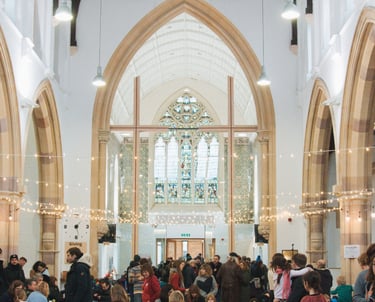
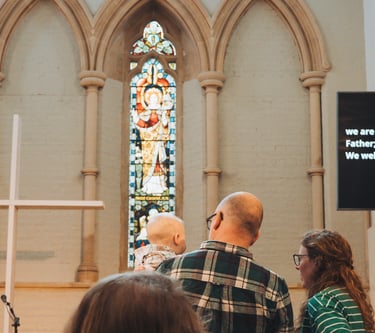
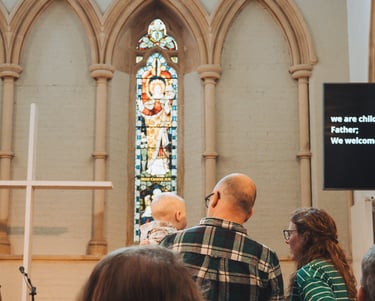
Stained glass was introduced into St. Barnabas in 1912 when the east window was fitted with five lights. These depict from left to right, St. John the Evangelist, St. Barnabas, the Ascension, St. Paul, and St. Peter. The cost of the new windows were defrayed between concerts and donations. The angels, we are told in the St. Barnabas year book 1922-23 "are the gift of the Sunday schools, Children's Pleasant Hour and Girls' Day School."

The social concern of St. Barnabas' ministry had through the generosity of a Mrs. Waters, issued in the building of six small almshouses down Seymour Street, off the Mill Road. These were opened just before Britain declared war on Germany in 1914. The almshouses were divided equally between St. Barnabas and St. Philip's and the incumbents and churchwardens of both parishes were the trustees. Another mark of practical help in the community at that time was their renting of a house for Belgian refugees in 1914 for the duration of the war which the parish furnished.

Before the departure of the Rev. W. H. Norman in 1926 and the subsequent arrival of the Rev. Ernest John Goodchild, a free will offering scheme was established which it was declared would "doubtless put the parish in a very strong financial position". Another innovation, the Parochial Church Council, set up in 1922, was also hoped to be 'in time, a great assistance to the clergy in all their parochial and spiritual ministrations'. The electoral roll was 400 strong and with the partitioning of the parish with St. Philip's, the population of St. Barnabas had dropped to a reasonable 4,451.

The Rev. Goodchild came to St. Barnabas hot foot from being organising secretary for the C.M.S. (Church Missionary Society). His first Sunday in charge coincided with the arrival of Miss Elsie Barrett and her sister Madge, who had just moved into the parish. "He was a nice man," Miss Barrett remembered, "But he became very'ill and left shortly afterwards due to his poor health." Miss Barrett's memories of St. Barnabas in the twenties are of a "nice little evangelical church with a moderate congregation. There were lots of families then, but the area was much as it is today except we knew who our neighbours were. It was a family area, I suppose, most of the residents were tradespeople, carpenters, stonemasons, shopkeepers, railway labourers, that sort of thing," she told me.

Leslie Wallis is another member of today's congregation who has personal recollection of that time. "I was working as a lab technician at the Perse Boys' School which was then on the Hills Road at the time. The vicar was a very tall sincere chap, he was married and I remember him as a quiet man. In those days of course the Sunday services would have the background purr of the gas lights which warmed the church up no end in the winter months," Leslie told me.

Electric lighting was installed before the end of the Rev. Goodchild's incumbency, and a scheme for the Jubilee of the church (1938) was drawn up with the intention of providing funds for the erection of the long-awaited tower and a peal of bells. This project yet again proved abortive. The Rev. Philip Henry Potter who was installed as vicar in 1933, had trained in Cambridge at Ridley Hall, and had been for many years the organising secretary for the Church Pastoral Aid Society. "He was tall and he was bald," recalled Miss Irene Claydon, who in those days helped run the junior section of the Girls' Campaigners, affectionately known as the Junos, a church youth group. "He was really very good," she continued, "I remember he'd go and preach at my home church in Ashley while they were without a vicar. My parents would often have him home for lunch, and he'd have duck and green peas." Malcolm laggard was a young lad attending Sunday School during the Rev. Potter's time. "I don't remember too much about him," he said, "Except he was a jovial man. He wore glasses and was tubby and bald." Throughout the 1930's a programme of re decoration and renovation was undertaken. The pitch pine choir stalls were pickled and lightened, the organ was restored, the chancel was whitened, and intricate stencil-work to the design of a famous church architect Prof. E. E. Richardson applied to its walls. The illuminated words, "Till He Come", were also set up over the communion table. The cost of over £1,000 was raised by the distribution of over 3,000 appeal leaflets by the Rev. Potter, who received generous responses from Kenya, South Africa, India, Greece and Singapore as well as the parish.

It was during this time that the choir, which had included both men and women as well as boys until that time, was changed by the organist and choirmaster Eric Coningsby (1937 - 40) into a male voice choir. Leslie Wallis joined the choir before the single-sex regime began. "There were six ladies, eight men and fourteen choirboys, and Mrs. Brown was choir-mistress. We had summer outings on Royston Heath and would spend the afternoon playing cricket. That was an annual event," Leslie reminisced.

Sunday services often rivalled the local cinema with the provision of the Cambridge Municipal Orchestra playing occasionally at Evensong. Christmas, Easter and harvest would see large congregations pressed into the church. "People still felt that they should come, that in some way it was their duty to come to church on these special festivals," Leslie reflected. The special service on Mothering Sunday dates from this time.

It was not only the choir who enjoyed the privilege of day outings. "We went to Wimpole Hall and Jesus College grounds on some of our Sunday School outings," Mrs. Jessie Ward, who was one of the superintendents remembered. "We'd give them a bag of sweets and an orange each and go off in coal carts with seats slung across. That was a common sight in those days, seeing schoolchildren go off on an outing with a lovely big horse puffing along the cart." The Junior Sunday School during this time met in Covent Garden Hall, which during the week was used as an overspill for Barnabas' Infants' School next door to the church.

The heyday of the St. Barnabas' Church of England School for girls and mixed infants was at the turn of the century. Catering for infants from 5 - 8 and girls from 8-12 years of age, the school records of attendance for September 1903 show a staggering intake of 167 girls and 108 infants, exceeding the maximum limit set down by the Governors of the Old Schools by 51 children. Later on, the school underwent a severe decline in numbers and when in 1959 the main school building by the church was declared unfit for continued school use, numbers had dropped to a paltry 30 pupils.

Derek Wilkin attended the Infants' School before it entered its decline. His memories of St. Barnabas speak of a bygone era. "Church was a really stern affair in those days, the boys would sit on the right hand side of the church and the girls would sit on the left. Mr. Patman who was the churchwarden would act as a sort of Justice of the Peace between us. It was all very formal and correct and not a little fierce," he recalled.

The Second World Ward saw the influx into the area of evacuated children from the areas of extensive bombing. Cambridge escaped with few scars from aerial attack. The Mill Road had a bomb fall on Donkey's Common, (where the Kelsey Kerridge Sports Hall and swimming complex now stands) and a young soldier was killed on the Mill Road bridge by flying bomb wreckage during another infrequent air raid. The shelters, seldom used, were on Gwydir St reet, where now stand the public conveniences. A simple scroll with the names of those who had died during the car was made by Thomas Livermore, a member of the church choir, and placed in the church. V.E. day was celebrated in muted fashion. Services of thanksgiving were held, but only in Gwydir Street, Great Eastern Street and Kingston Street were flags strung up and parties in the street.

The Rev. Potter left before the conclusion of hostilities in 1944 and was replaced by the Rev. Albert E. Rushton, who was instituted on March 5th 1945. When Ted Rushton first saw the church he was somewhat surprised. "I remember coming around the corner of St. Barnabas Road and seeing this huge golden cup on top of the church. I went back to Somerset and told my wife, "What an extraordinary church. It hasn't got a tower or a steeple but instead, this huge chalice on top of the roof." It wasn't until later that I discovered that this chalice was the trade mark of Dales Brewery (now Dales Language School) in Gwydir Street, and wasn't part of the church building at all, just a visual trick."

The arrival of Mr. Rushton continued the concern for mission overseas, which had been set by the Rev. C. Butler back in 1889. The Rev. Rushton and his wife Betty had been working with B.C.M.S. (Bible Churchmen's Missionary Society) out in Burma for 18 years, until they were evacuated out in 1942 when the Japanese invaded North India. A 'muddy Exodus' was how Mr. Rushton viewed his experience in a book written when he had returned to Britain. The link with missions was to continue with Margaret Pooley, an active church worker going out to Nigeria and currently Andrew Barclay a young Cambridge doctor out in Tanzania.

Before Margaret Pooley left for Africa, she helped Minnie and Vera Sargent run a lively group for young church members in their twenties called^'Christian Endeavour". One of those who went along was Pat Wilkin who was then a clerical assistant at Simplex Dairy on the Hills Road. "There were about thirty of us who would go along each Tuesday night, and the "Sargies" would lead us in Bible study and then we'd break into other activities," Pat recalled.

Entertainment along the Mill Road hadn't changed much since the 1920's. The Kinema opposite the church was still immensely popular, with entry costing a mere I/-. Down on the corner of Covent Garden was the Playhouse which before the second world war had been a highly sucw ful variety hall. Now it was a film theatre with a difference. "There would be some singing and dancing on the stage in between the films," Leslie Wallis recalls, "It really was a superior type of cinema, quite luxurious and grand!" Knocked down in 1964, making way for Fine Fare's supermarket, Mill Road lost in the Playhouse's demise its last salubrious theatre.

The complexion of the Mill Road changed significantly in the 50's and 60's, in marked contrast to the stability of the inter-war years. Insiduously young families moved out of the area as house prices rose. A new social mobility had arrived and youngsters no longer felt tied to the district for their job prospects. The church soon noted the change. Sunday School numbers dropped off as homes were turned over to flatlets and bed-sits. The district became increasingly cosmopolitan with the growth of the language schools and the international intake of the Cambridgeshire College of Arts and Technology burgeoning. "There was a gradual but perceptible dropping away from church attendance from the 1950's onwards," remarked Bob Francis who was then a representative with Withers United Dairies. "The range of activities that can draw young people away from church, like radio, television, parties and Sunday cinema, increased enormously during this time. Meanwhile the average age of the congregation crept higher and higher as the numbers inexorably dropped."

Ron and Elisabeth Marriott were one young family who were forced out of the area. A lay preacher at St. Barnabas, Ron had joined the church's Bible Class as a nine-year-old. "I joined after I had gone on the Boys' Camp which the vicar, Mr. Rushton, ran every summer for a week. They were normally held out at Hemingford Grey, were under canvas and great fun. From then on I joined the Bible Class and went on to help teach the Sunday School." When Ron married Liz a few years later they found accommodation a problem. "There was absolutely nothing suitable available, and situation got worse when we started a family. The pressure for housing in the area has always been high as long as I can remember. We couldn't afford the prices of the houses this end of town, so we moved out to Chesterton." The tale was the same for many as family homes became bed-sits and flats.

One event in the summer of 1966 stood out for many of the congregation as a statement of the altered times. On August 29th in the middle of the Bank Holiday afternoon, a group of teenagers walked into St. Barnabas and set light to bundles of Hymn Books and Bibles in the chancel. The Cambridge News reported that "The church looked as though it had been blasted by a small bomb." The congregation was shocked. "We were very upset and angry that someone could do that sort of thing to God's House," Miss Elsie Barrett told me, "It wasn't done for robbery or gain. As far as we could see it was just desecration." After years of habitually being open the doors of St. Barnabas' Church were shut.

In June 1977, after 32 years of continuous service in the parish, the vicar, Ted Rushton, retired. Summarising his time at St. Barnabas, Mr. Rushton told me that he and his wife had been "very, very happy. We loved it. I was always blessed with super duper Churchwardens and there are no regrets." The feeling it seems is mutual. Bob Francis, who has been Churchwarden since 1964 confided, "He was a forthright man and left us in no doubt about the message he had to preach. He was extremely popular and very good with children." Leslie Wallis confirmed the story. "He was untiring in his energy and influenced a number of men powerfully in his preaching. Brian Whittaker, Cliff Wright and Claude Flood all went into the ministry during his time here with us."

The Church Today

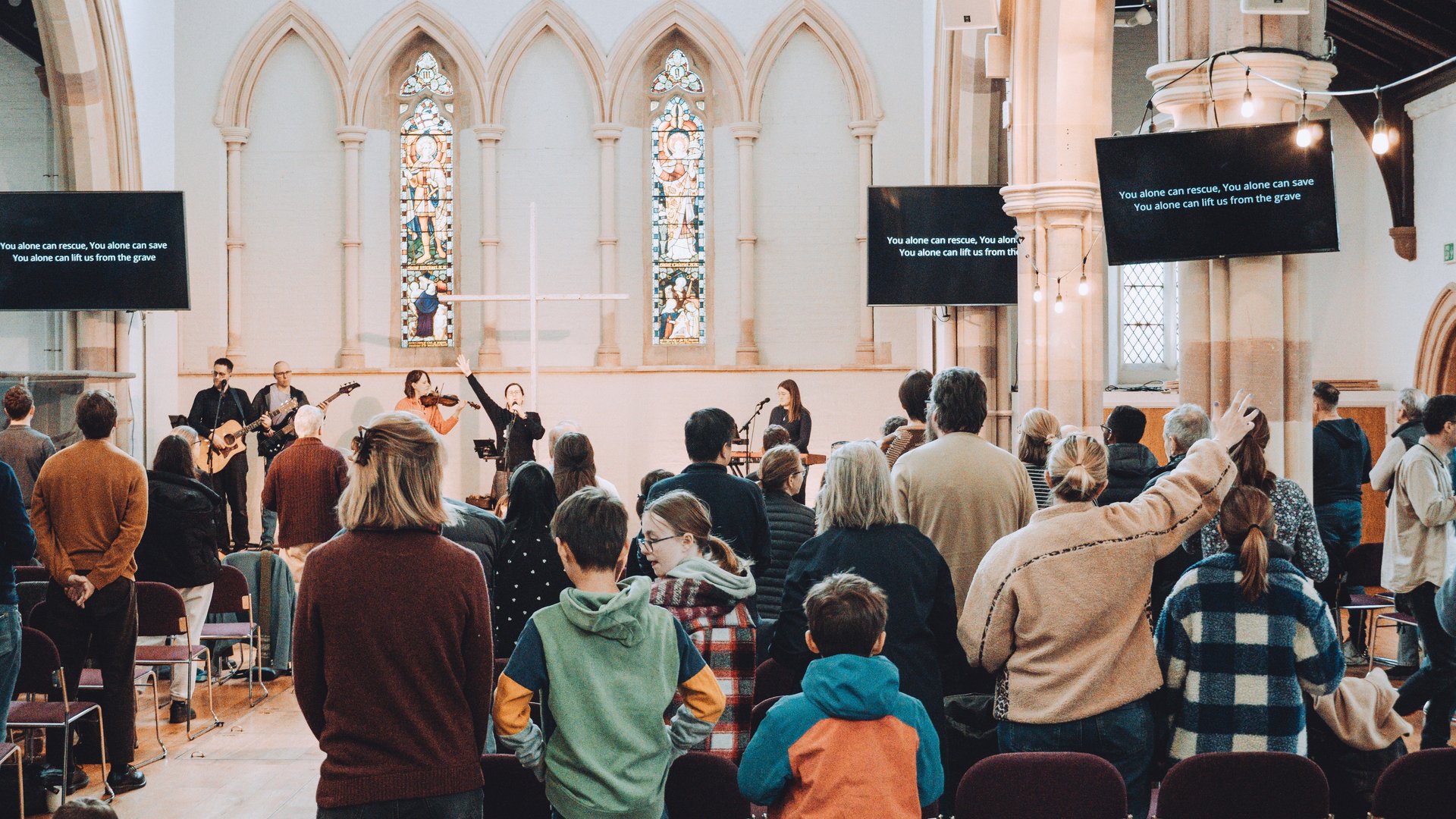
On October 6th 1977, the Rev. Dennis Lennon was instituted at St. Barnabas by the Bishop of Huntingdon. He became the church's seventh vicar and inherited many organisations which had spanned the years between. The eldest of these is a uniformed organisation known as the Boys' Brigade.

The declared object of the B.B. is that of "advancing Christ's Kingdom among boys." The movement was founded in Glasgow on the 4th October 1883, by William Alexander Smith. Smith was a Sunday School superintendant who was experiencing great difficulty in teaching the rebellious and indisciplined offspring of the Glasgow slum tenants. The Boys' Brigade was his answer to the problem. The discipline and drill of the Brigade made it possible to teach the Bible to the boys without heckling and other distractions. By 1894, the movement had claimed St. Barnabas, which now boasted the 2nd Cambridge Company, and boys flocked in from the Mill Road area. The uniform that was sported in drill incuded rifles as well as hats and gleaming white belts. Bible study was equally a part of the Brigade's activities as gymnastics and the yearly Summer Camp. In 1897, the 1st Cambridge Company which was attached to St. Mark's closed down but it wasn't until 1907 that St. Barnabas B.B. inherited the title. By this time Boys' Brigade activities had spread to such educational pursuits as carpentry, drawing and arithmetic. Only when the Local Education Authority established evening classes at the Technical College did these extra-mural activities drop out of the B.B. programme.

Today's Company Captain is Derek Wilkin, a senior technician at Pye Limited. With the help of his five officers, Derek runs three main evening meetings a week, as well as the B.B. Bible study on a Sunday morning. One of Derek's main concerns for the B.B. is to see the boys become integrated into the life of the church when they pass out of the Brigade at eighteen. Derek's commitment to this springs from personal experience. "My parents were non-practicing Methodists and I joined the Boys' Brigade at the York Street Mission which was close to Hooper Street where we lived. This closed down after a few years and I transferred across to St. Barnabas where the B.B. was just starting up again after a break during the war. Geoff Hewitson who was the Captain between 1950 and 1957 was to become both my Godfather when I was baptised into the church at eighteen and also my best man when I got married to Pat four years later. Geoff was Bank Manager at the Trustee Savings Bank on the Mill Road, and we all used to meet down in the cellar underneath the bank each Sunday after evening service. We'd chat about everything under the sun and drink coffee. That was really enjoyable. It was through the Boys' Brigade and particularly the inspiration and leadership of Geoff that I entered into Christian life and involvement with church life at St. Barnabas.

The Boys' Brigade at St. Barnabas now boasts a company strength (12 -18 years) of 15 and a junior section (8-12 years) of 13. Many of the boys come from outside the parish, although on a recent recruiting drive several boys came forward from within the locality. Seen very much as a frontier movement, the B.B. is often the only contact that many of the boys have with Christianity. "Just because a boy is a member of the B.B. it doesn't mean that he is interested in the life of the church," Derek explained, "But we hope that through the work of the B.B., boys will think seriously about Christianity." All the officers are active members of the church and a number of sidesmen and P.C.C. members have been part of the movement. "We do have problems with keeping boys after they reach 16. It's then that they leave school, find work and discover other things to do with their spare time. There's also the fact that the area just hasn't got many families living here. I suppose ideally we should move to the Arbury Estate or somewhere like that where the kids are, but we'll stay here because of the links that the Officers and myself have with St. Barnabas," Derek told me.

The youth work of the church is not limited to the Boys' Brigade. In the early 60's, a Young People's Fellowship emerged under the leadership of Granville Hawkes, (organist/choirmaster/lay reader), and Ron Marriott. The group was a lively one. "There were about 30 of us, pretty much from this area. We'd have sausage sizzles, rambles, trips on the river, during the week, and on Sunday evenings we'd meet for Bible study after church." For a while the Y.P.F. paper Spearhead sold better than the church magazine. "There was some hard competition there for a time," one old member reported. A sizeable proportion of the Y.P.F. became actively involved in the church. Stephen Leeke, (Secretary Sf the P.C.C.), Peter Boyes (Sunday? School leader), Ken Hames (an officer in the Boys' Brigade) all were members of the group, which wound up in 1964.

In June 1978, a new youth organisation was launched under the name of Pathfinders. Part of a national movement, Pathfinders takes children from the ages of 11 -15 and runs national youth rallies and camps for youngsters throughout the country. Alec McCallum was St. Barnabas' first Pathfinder leader. "There was nothing in the church at that time for the girls, or for boys who didn't want to join the Boys' Brigade. So we had children leaving Sunday School with nowhere to go." There had been a Bible class but this was segregated between boys and girls. The new mixed Pathfinder group proved a much more attractive option. "Pathfinders grew out of a genuine need in the church and immediately attracted and still attracts today kids at a crucial time in their lives. They're treated as responsible youngsters and given the opportunity to get involved as the junior part of the church. I see the setting up of Pathfinders as an authentic movement of the spirit. Kids poured in and enjoyed every minute and so did I," Alec said.

Nearly two years later the leadership has been taken up by Jackie and Gary Donaldson, who have been helping Chris Summerton and Sally Baker with the group over the last 10 months. There are now 15 children attending the Sunday meetings. Drama, crafts, .ausic and discussion all play their part in the life of Pathfinders. It provides a forum for children to air their views. "The number of children who still see God as a white-bearded old man surrounded by angels with harps is really incredible," Chris Summerton told me, "A large part of our time in Bible study and discussion is spent clearing up what are extremely childish notions. The friendships that have grown up in the group, through the various activities, have been really fruitful and fun. I've enjoyed the work immensely and feel I've learnt almost as much as the children."

A gap is still seen to exist in the 13 -18 age group since the demise of the Y.P.F. "The Pathfinders who are coming out of the top end should provide a pool for some sort of youth group," Chris hopes. "The older Pathfinders are really keen that this should happen and there is tremendous scope in Cambridge to make an interesting programme for them. It would be good to see them grounded in basic biblical truths, and I see the seeds of this happening in the vicar's young people's Bible study on a Tuesday evening which 7 - 8 of the older Pathfinders attend."

Gone are the days of the Girls' Campaigners, where girls would learn the mysteries of rope knotting, the seasons of the Church Year, drill display and Bible verses. The Sunshine Circle which catered for the young mothers in the parish also passed into history. However the young mothers of today have not been forgotten. The Mums' and Toddlers' Group which started up in 1979 is an important contact point between the church and the wider community. On average about 10 mothers turn up each Wednesday morning with \% toddlers each, to talk and drink coffee with one another while the children play and create mild chaos. "It's so important to just get out of the house when you!re stuck alone with young children all day," Margie Anderson, the leader of the group explained. "There is a high turnover in the group. Nearly every week somebody new comes along. It's not a formal group or meeting. We just provide a place for mums to bring their kids and let them play with the others while they can have a chat and a break. This kind of thing is available in a lot of churches today," Margie told me, while Christian, her ten-month-old son gurgled happily down the phone.

The Women's Group, which has an ancestry stretching back before the war when it met twice weekly, still flourishes. Led by Sonia Lennon, the group has a wide age range from 55 through to 80 years. A broad spectrum of interests is catered for, with talks, slide shows, open discussion and always a short devotional message. For many of the thirty regulars this meeting is the only form of teaching and fellowship available. "Once a quarter we, have a members' meeting, which is a time for people to open up and share what has been happening to them, and it is amazing what comes up in these," Sonia told me.

The church is very much aware of the elderly and housebound who live in the parish. David Thistlethwaite now heads a team of 21 visitors who go out and visit on a regular basis a number the many elderly in the area. David, who is currently researching a Ph.D. in Aesthetics at the university, was prompted to action during the Parish Mission in October 1979. "The team was already in existence then under Margaret Hudson's leadership. I had a very strong sense that we needed to help the elderly to feel much more a part of the praying body of the church. I suppose there may have been an element of making the elderly useful in this, which I realise is quite mistaken. It is difficult though for those who can't come along to church to feel really a part of it, and we must recognise this. I sometimes wonder whether we couldn't start up a mid-week communion which I'm sure would be used and appreciated, if only by a handful of them."

"In this sort of work it is very difficult to see what we have achieved. Of real value is the contact that has been established between individuals, with personal support and friendship and support growing out of the visiting. Some people do seem to have splendid Christian times with those whom they visit, while others don't. Really what is important is not our ideas of how things should go but treating the people one visits with respect, recognising the stage that they're at. There has grown up real friendship from these visits and I am concerned to see prayer for this side of the church's work increase."

At the other end of the age spectrum is the work of the Sunday Club. For many years run by Vera Sargent (St. Barnabas' Lady Worker), the Club has been run since the mid 70's by Peter Boyes. Numbers have been falling relentlessly over the last two decades. Difficulty in securing staff, the movement of young families away from the district, lack of support from the church membership, all these have contributed to the decline. "Life had become very difficult for the leaders. All the vigour and enthusiasm had gone," Ron Marriott who now leads the Junior Section of the Club recalled. Slowly over the months attendance has revived. "Numbers have picked up mainly by the happy accident of new families moving into the area and coming along to church," Ron told me.

One interesting development for the future is "Barney's Club", an after school club for 6 - 11 year olds run each Friday by two Homerton students, Vivian and Angie. Games, drama and stories make up the action-packed hour from 4.15-5.15 pm. This new venture sprang up out of the Easter Holiday Club, which proved a surprising success. Over 20 children came along to enjoy the swapshop, filmstrips and the host of other activities that were laid on. Most of the children were from the area, a tremendous encouragement for the leaders, most of whom had given up a week's vacation for the club. "The kids seemed to have had a tremendous time," said Ron, "And it would be good if we could see them joining the Sunday School after this introduction but it's a matter of wait and see on this one."

Most of the church organisations use the Memorial Institute for their meetings. The name of the building however has been updated and is now generally referred to as "The Barn". A simple yet catchy abbreviation of the apostle's name, the Barn has come to mean for many hundreds of the thousands of language students who pour into the city throughout the year, friendship and a home from home. The Barn opens each Thursday evening with an assortment of activities for overseas students to enjoy. The coffee bar atmosphere is strong, but so is good music and intercultural ventures such as the Chinese tea ceremony, Thai folk dancing and a Swiss evening held recently. The Barn relies on making use of whatever cultures are available.

The Barn first opened for overseas work in 1977 with special evenings being held once a month for language students. After the 1978 Overseas Students' Summer Outreach, a Cambridge-wide mission to the language schools, the Barn opened its doors every Thursday as a meeting place for the students. Within a few months the upstairs hall was full with 80 -100 language students making the Barn a weekly date in their diaries. What was the secret of its success? Chris Butt, now curate at St. Barnabas, was International Co-ordinator for student work in Cambridge that year, and had a special interest in the Barn. "We had a large and committed team, who showed great imagination in running the evenings, so the programme on offer was varied and consistently good. We were also concerned to make it a genuinely Friendly place which could become a real centre for friendship. The advertising was well done too, with language schools being regularly visited and the coffee-pot-welcome cards distributed in all the key places."

A major part of the family atmosphere is generated by the wide age range of the helpers. Bob and May Francis are happily referred to as the Mum and Dad of the Barn. Their house is always bulging with students from overseas either staying or drinking coffee and tea with them. "The Barn is often the only contact some of these students ever get with local people," Bob told me. "It's something we all enjoy, and Thursday evening is a great time for everyone." The Barn now hosts the Overseas Outreach during July and August, when students from British and European universities come to share the Good News of the Christian faith with the flood of students attending summer courses. "It's such a tremendous opportunity," Chris Butt told me. "This enormous surge of people from all over the world, with a great desire to meet English people, seeking friendship and often desperately lonely. When they arrive in Cambridge they are freed from the cultural restrictions on thinking about their religion that are often there in their own country. Many of them come to think about and read the Bible for the first time due to the Summer Outreach programme, something that could never have happened in their own land," Chris said.

This encouraging breakthrough in the church's work with overseas students has been mirrored, though less dramatically, with the other main student body resident in the parish. The Cambridgeshire College of Arts and Technology has over 4,000 full-time students on its register and many of these live in the Mill Road area. The college has had an attachment with St. Barnabas over the last twenty years. The Rev. Rushton used to take morning devotions there in the late 1950's, but noticed his time there being slowly cut back as morning assemblies lost their religious content. By the 1970's the Christian Union at the Tech was in a dilapidated state with less than 20-C.U. members struggling to witness to their classmates. When Dennis Lennon was appointed vicar of St. Barnabas it was with strict instructions from the Bishop of Ely to do something about the Tech.

"The work that was waiting to be done was vast," Dennis told me, "But it was impossible to do a genuine job there and to pay enough attention to the pastoral work and teaching ministry here at St. Barnabas." On the strength of this, the diocese gave us Chris as curate, to open up the Christian work at the college." There is no special formula for working with the students at the C.C.A.T. "Most of my time is spent talking to and encouraging members of the Christian Union," Chris told me. "I am convinced that the best way to minister to the Tech is to have a lively Parish Church for students to come along to. Many of the students do live in the parish, so St. Barnabas is in a very real way their church. We've seen a steady increase in students coming along on a Sunday, and the reason many of them give is that the church really has made them feel welcome. In turn, the students themselves have given a lot to the church.They play an important part in the music group which has recently formed and encourages us in praise and worship each Sunday. So the traffic isn't all one-way. I think the work with the C.C.A.T. is just one part of making St. Barnabas really rooted in the area and a living witness within the community."

Andy Vass is a first year studying graphic design and illustration at the C.C.A.T. He became involved with St. Barnabas after the Parish Mission last October. "I came along that week because of my flat mate, and what I heard from the missioner, Daniel Cozens, really bit me. I committed my life to Jesus Christ and came along to St. Barnabas after that as the natural place for me to attend." Andy also goes to the Bible Study run by Chris Butt every Tuesday for students from the Tech and Homerton Teacher Training College. "My link with St. Barnabas goes on throughout the week. I often do some artwork for the church and that is a form of witness in the Art Department. Chris' Bible Study Group is very helpful and on a Sunday there is the warm fellowship of the body of Christ there at church."

1980 sees St. Barnabas with a wide variety of organisations and people within the church. Attempts are made to help the different generations and church groups to work together and understand each other. One of the main avenues for this is the development of House Groups. Stuart and Dee Dyas lead one of the seven House Groups that meet around the parish. They remember the days when the first tentative three House Groups were set up. "It was February, 1979, just after Luke was born, and we felt as a church that there was a real need to see the centre of St. Barnabas' membership built up and strengthened," Dee told me. "As a church, we were becoming very keen on evangelism, but we needed to develop fellowship within the body, so that there was actually something there to bring people into."

"The home is a terrific place for this sort of mid-week fellowship, because of its informality and also because it gives room for expansion and growth. Once the room is too full, the natural answer is to set up another House Group elsewhere." Stuart and Dee's group has already split once, giving birth to a new Bible study group down the Mill Road. Even so their group has 13 regular members and a further 11 occasional. "There's hardly room to get in the door sometimes," Leslie Wallis remarked.

Stuart believes firmly in the importance of these House Groups for the life of the church. "Many people at first were very nervous about these groups when they started,up and didn't want to get involved. The funny thing is that once these folks come along and join in the fellowship and friendship, discover how to pray openly in a relaxed atmosphere and study the Bible with others, they wonder how they ever survived without it. Of course it is a thing that has had to be worked at. But now we see genuine friendship having grown up between the young and old members of the group which is tremendous. There are all sorts of social and intellectual backgrounds and abilities represented here, which makes the whole thing really creative and growth-inducing."

Evangelistic suppers, parties and two. Iranian evenings have all played a part in the House Group's calendar. Saturday morning coffee is now regularly offered in the Barn for Mill Road shoppers. They have proved an important contribution in the House Groups' outreach. "You meet all sorts of people who are eager to chat over a cup of coffee, about everything and anything. Often there are real spiritual issues to talked over which are raised by some of the folk who come in," Stuart said. House Groups also help in leading prayers in Sunday worship. "It is important that House Groups are participating in the life of the church in this way," Dee commented. "People are beginning to gain confidence in themselves and in the gifts that each one of them has been given by God for the benefit of each other. Increasingly the pastoral work of the church is being taken off the shoulders of the vicar and being placed where it belongs, within the church membership as a whole, the Body of Christ."

The Church Tomorrow
An interview with Dennis and Sonia Lennon.

The church had just celebrated Easter when I went along to talk to Dennis and Sonia in their rambling home, so nobly described by the late H.C.G. Moule nearly a century ago. Married in Thailand, where they were both missionaries with O.M.F. (Overseas Missionary Fellowship), Dennis and Sonia retain their concern for mission and evangelism at home and abroad.

"When we came to the parish just about 2½ years ago, we didn't know a great deal about the nature of the district. We knew about the cosmopolitan make-up of the area from our work with overseas students at the Round Church where I was curate, and this was something that we both found attractive. We were also aware of the C.C.A.T. and its importance in the ministry of St. Barnabas. When the former Bishop of Ely appointed me to this living, he described the Tech: as "the most urgent pastoral job in Cambridge". So we were conscious that both the overseas students and the Technical College would be important features in the life of the church."

"One thing that I came to realise was the diversity of groups within the parish. There are many elderly people, a growing number of young families, students from the language schools and members of the Tech. This variety of people within the parish boundaries caused us to reshape some of the traditional church practices. It was the need to exercise a ministry towards the Technical College and some of these other groups that decided the P.C.C. to move over from the 1662 prayer book and establish the modern liturgy of Series 3 as our format for main services."

"The style of worship that we are working towards as a church is one in which we can enjoy the benefits of liturgy, its order and direction, but also one where people have sufficient freedom to express their worship of God. This we hope to encourage in a variety of ways, through occasional use of drama, through singing, using the Music Group and the Choir, through the participation of members of the church leading prayers, reading the lessons etc. What is of supreme importance is that Jesus Christ is seen to be Lord and that we express in our church life the fellowship and the love which is an essential part of the Body of Christ. Anything that is of help to us here must be considered seriously."

On Easter Sunday the Pathfinders contributed to the worship by producing a colourful display of banners and posters declaring essential truths of the Christian faith. "Jesus Christ is Risen", "Jesus Christ is Lord" were emblazoned on the makeshift bamboo and cotton. The central poster over the altar caught Dennis' attention as a vigorous statement of Christianity. Pointing to the banner depicting a lamb enthroned, having defeated the cross of Calvary and the tomb, Dennis exclaimed, "This is no cuddly Lamb, but rather a stern and victorious one." "Those banners by the Pathfinders brought home in a punchy and attractive way some of the key truths that as Christians we live by. I found them very helpful," Dennis reflected afterwards.

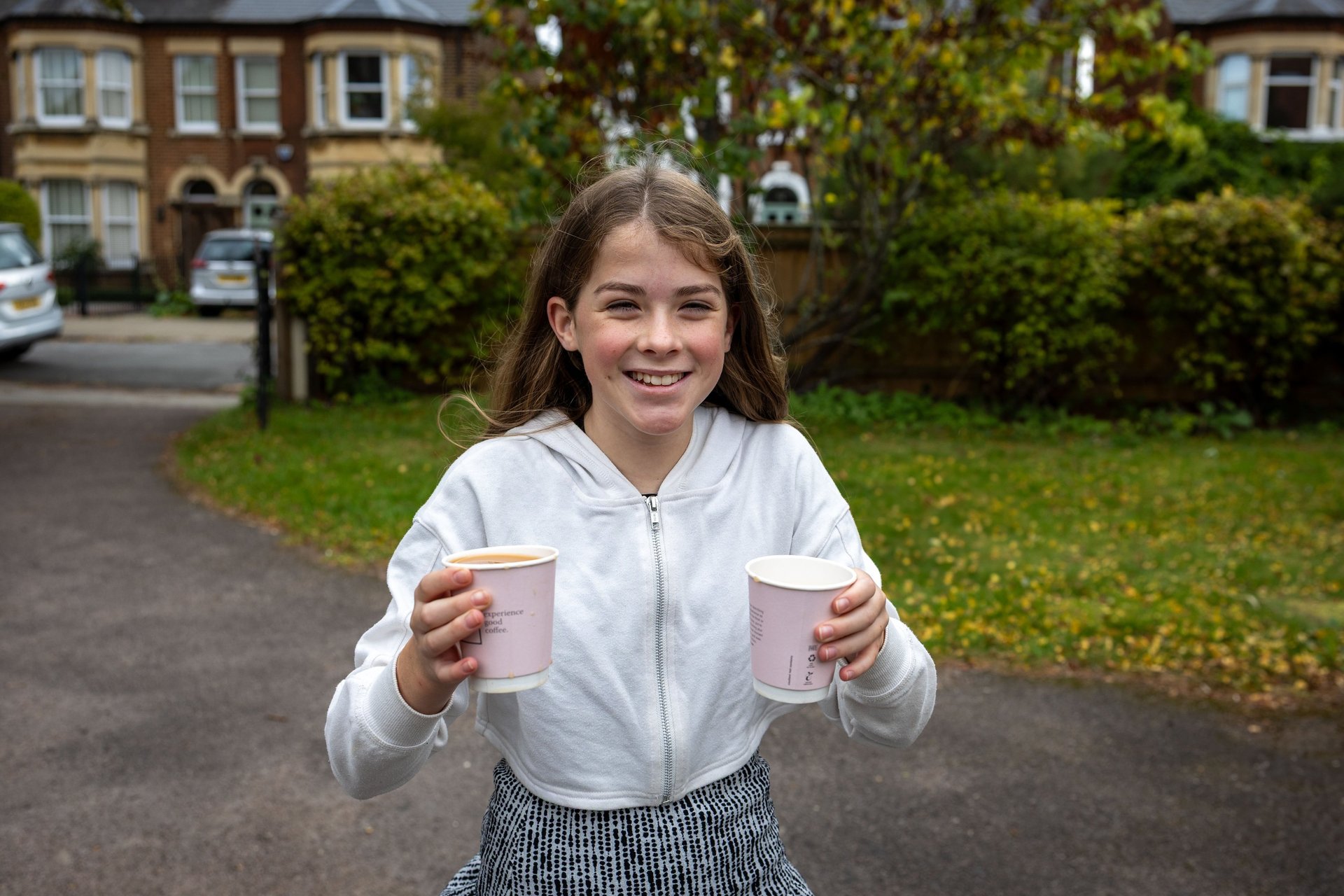
One innovation is that tea is now regularly served at the back of the church after morning service. "It's a simple form of hospitality," Sonia told me. "It's what I would offer anyone coming into my home, it helps newcomers to feel welcome in the church and also encourages people to stay behind after service and talk to one another." The Peace of Christ in the series 3 communion service is celebrated by a handshake and a brief relaxed greeting. This is seen as a sign of barriers being broken down and practical fellowship and friendship being established in Christ.

"I'm very concerned to see St. Barnabas become an integrated part of the Mill Road area, and equipped to minister effectively to the needs of people in this parish. There are for instance a large number of elderly folk who are housebound and often extremely lonely. We need to befriend them and spend time with them as part of our practical Christian witness in the locality. The pastoral team for visiting the elderly which has developed over the last few years is, in my opinion, one of the most vital Christian activities in the church. The Mums' and Toddlers' Group is also significant in its impact on the community. It brings us into contact with a number of young mothers who have had no interest or links with the church before.

It is important that we should be thinking of how to relate in a relevant way to the needs of the area. The Shire Hall projection for the Mill Road district is that it will be the fastest regenerating area in Cambridge. That means that young families will be moving back into the parish, and we must be there ready to meet them in whatever way is appropriate."

The blue board outside the church facing the Mill Road carries an ever-changing selection of Christian slogans. "Love is down and out," "We are the soul agents of this parish," "Jesus lives. Come into the Sonlight," daubed in white emulsion attract the attention of the Mill Road shopper. Dennis sees it as part of the Church's identification with the area. "It's rough and straightforward, there's nothing pretentious about it. It's spontaneous Christian graffiti. People either love it or hate it, but it is part of the church looking outwards, and I believe it expresses the idiom of the district."

"As a church we are concerned to be looking outwards, and we need to be thinking about how we can make the church open and accessible to those outside. The ability to go out and contact totally uncontacted people, demands imagination and innovation and we must be praying for this as a church. The parish mission in the Autumn has now become a regular feature in the church's yearly calendar, and this plays a significant part in keeping us aware of the wider parish. It also helps us establish links with those who have recently moved into the area. The district changes significantly over the summer months. Families and students move out and are replaced by newcomers. This week of concentrated mission stretches us and focusses the energies of the church into purposeful Christianity. Last year's mission "Bridge Week" gave rise to the birth of five new House Groups which have been of great importance in the developing life of the church."

Sonia Lennon is one of the new breed of post-war clergy wives who works as well as exercising a varied ministry within the church. As a laboratory technician at the Medical Research Council out at Babraham, Sonia finds her work a significant part of her Christian outreach. "I meet a lot of people who are completely on the outside of church life, and am able to share something of my Christian faith with them." However, this combination of being a working woman and a clergy wife is not without its tensions. "I strive not to divorce my professional life from being Dennis' wife and a mother of two teenage children, but it is sometimes very difficult. My life does have several compartments of different activities, but there is a unifying strand, and I believe firmly in being Dennis' wife and partner," Sonia confided.

An important feature of Dennis' ministry is the teaching and expounding of the scriptures. "I believe this to be a central part of my work here," Dennis told me, "And vital for growth within the church. The word of God is not a soft and comfortable thing, rather it is a word that forces us to rethink everything in the light of what God has said. This means that the great doctrines of Salvation and Judgement effect our everyday lives as Christians and give our lives real impact. What I hope we as a church are doing, is giving Christians the strength and power to live for Christ in spiritually demanding places. As we open ourselves to God's word and expose the secular in our thinking and our lives, so we move on in our obedience and maturity in Christ. I preach in order that Christians may think and act like believers, seeing themselves and the world from an eternal perspective. So that just as Jesus was physically at the head of that tiny band of disciples in Palestine 2,000 years ago, we would see Jesus Christ as our Lord and Master in the church today with similar clarity.

What remain as some of the dreams for the 80's?

Dennis: "I would hope to see the developing pattern of quality and depth in our church life continue to grow. We have good foundations in the friendliness and openness amongst the church's members, which has been enriched over the last year by the House Fellowships. I want to see Christians equipped to serve the Lord whereever He calls them, and to be ready and able to make disciples. There are signs of a new concern for missionary work overseas in the church, and I look forward to people offering themselves for work abroad from amongst us."

Sonia: "My prayer is to see us grow up into a community of people with one mind and one vision, yet allowing the freedom for many different approaches and ideas to be held and tried out."

Dennis: "Above all, I want St. Barnabas' ministry to be equipping Christians to be practical believers each day, in their work, homes and in the community around us. As we move into the next decade, I pray that St. Barnabas will become increasingly relevant to the area, an indigenous church whose members make a steady Chritian Christian impact upon the parish, as we open ouselves to serving Christ and His Kingdom here in Cambridge."

Unless the Lord builds the house,
those who build it labour in vain.
Unless the Lord watches over the city,
the watchman stays awake in vain.
- Psalm 127


Appendix

1862 Cottage meeting starts in Covent Garden
May 1867 Appeal launched for funds
June 10th 1869 Foundation Stone for chancel laid by Bishop of Ely.
June 11th 1870 Chancel opened by Rev. H. Hall (vicar of St. Paul's)
November 12th 1877 Appeal for church extension launched.
1877 Infants' School built along side of St. Barnabas by the Governors of the Old Schools.
October 26th 1878 Memorial stone laid by Rt. Hon. Earl of Hardwicke for church extension.
May 4th 1880 Consecration of St. Barnabas by Bishop'of Ely.
February 16th 1886 Guildhall Appeal for further enlargement of the church and formation of an Ecclesiastical District.
December 17th 1888 Ecclesiastical District confirmed by Her Majesty's Privy Council.
June 1889 Foundation stone for St. Philip's laid by Professor Babington.
May 1st 1890 St. Philip's opened and dedicated by Bishop of Ely.
March 13th 1890 Site given by Gonville and Caius for parsonage house.
June 1894 Vicarage opened and dedicated by H.C.G. Moule (Principal of Ridley)
May 6th 1897 Foundation stone of Babington Memorial Institute laid by Rev. C. Taylor D.D., Master of St. John's College.
June 11th 1902 St. Philip's consecrated by Bishop of Ely, with independent Ecclesiastical District.
November 8th 1906 Covent Garden Hall aopened by Vice Chancellor, Rev. E. S. Roberts M.A.
1907 - 1908 Land purchased from Caius College adjoining Covent Garden Hall releasing the Drill Hall to become Infants' School overspill during the week.
June 11th 1912 East window unveiled by Bishop of Ely.
July 1914 Waters Almshouses opened.
1919 Two lights in west window and memorial tablet placed in church for those killed in First World War.


Architect and Builders

The Chancel Architect: Mr. Talbot Bury of London
Builder: Mr. Attack
The Nave

Architect: Mr. H. W. Bassett Smith of London
Builder: Mr. F. Thoday and Son, Messrs. Bunning

The Memorial Institute ('The Barn') Architect: Mr. W. M. Fawcett
Builder: Mr. W. Saint
Vicarage Architect: Mr. Ewan Christian of London
Builder: Mr. W. Saint
St. Philips District Church Architect: Mr. Loftus Brock
Builder: Messrs. Wade of St. Neots
Covent Garden Hall Builder: Messrs. Willmott


Vicars

February 1889 Rev. C. Butler installed as first vicar
1892

Rev. J. W. Thomas

1907 Rev. W. H. Norman
1927 Rev. E. J. Goodchild
1932 Rev. P. H. Potter
1945 Rev. A. E. Rushton
October 1977 Rev. D. Lennon
?

D. Holt

1994 Rev. L Browne
2001 Rev. N. Ladd


Churchwardens

1880

First Churchwardens selected by St. Barnabas congregation:

  Mr. Blackett Mr. Curtis
1887 Mr. W. R. Bright Mr. W. Saint
1891 Mr. J. Clark Mr. W. Saint
1895 Mr. J. Stephens Mr. W. Saint
1898 Mr. H. Stevens Mr. W. Saint
1910 Mr. A. Muirhead Mr. W. Saint
1911 Mr. J. H. Freind Mr. W. Saint
1915 Mr. G. A. Turner Mr. W. Saint (Counsellor)
1918 Mr. J.H. Freind Mr. W. Saint
1919 Mr. A. Muirhead Mr. W. Saint
1922 Mr. A. Muirhead Mr. W. Saint (Counsellor)
Gap here. Neither Spladings Directory nor Ely Diocesan Handbook list Churchwardens in these years.
1936 Mr. A. Muirhead J. Tyler
1937 Mr. A. Muirhead H. E. F. Pateman
1946 Mr. T. B. Proctor H. E. F. Pateman
1950 Mr. T. B. Proctor H. E. F. Pateman (J.P.)
1953 Mr. G. Hewitson H. E. F. Pateman
1960 Mr. C. E. Flood H. E. F. Pateman
1961 Mr. C. E. Flood Mr. P. Hammond
1964 Mr. L Wallis Mr. R. Francis
1967 Mr. A. Palmer Mr. R. Francis
1980 Mr. A. Palmer Mr. R. Francis


Organists and Choirmasters

1898 Mr. Percy Pain
1912 Mr.G. Flavill
1920's Mrs. Maurice Brown, L.R.A.M.
1937 Mr. Eric Alfred Coningsby M.A.
1940 - 44 John St. John Potter
1940's - 50's Jack Snazle
1950's-67 Granville Hawkes
1967 John Reynolds
? John Wells
? Ann Page


Service times

  9.00am
10.30am
  7.00pm

   more...

What's happening?

CFN...
Calendar... Preaching Programme...

Sermon audio

Sermons are available online
listen...
Alpha in St Barnabas

Looking for answers?
The Alpha course is an opportunity for anyone to explore the Christian faith.
more...

Members' area
Members' area.
go...


St Barnabas Church, Mill Road, Cambridge, CB1 2BD · tel: 01223 519526 · fax: 01223 576256 · e-mail:
Copyright © St Barnabas Church, Cambridge, UK · Errors/Comments?