HISTORY

Over the period of 30 years, 1860 – 1890, the population of this area increased from about 700 to 6,000, the area changed from rural to urban, particularly influenced by the construction of the Great Eastern Railway. The area was mostly occupied by artisans. Many of the men worked on the railway. Others included shop keepers, college bedders and servants.
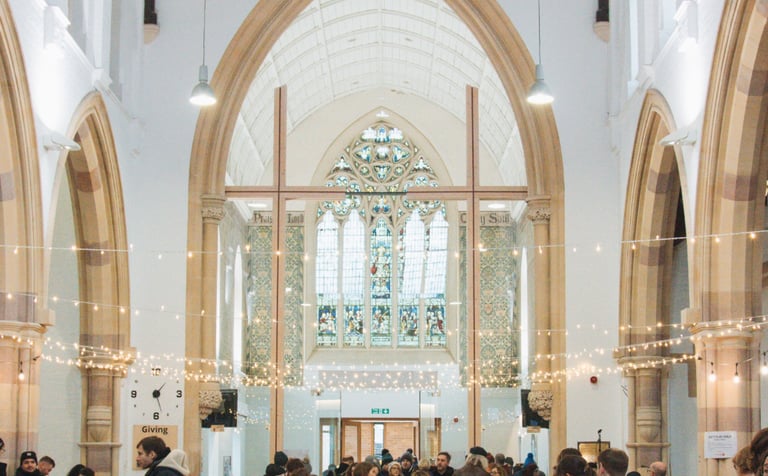
St Barnabas began as a mission outreach by St Paul’s Church, Hills Road in 1862 with a an evening meeting taking place in a cottage in Covent Garden. St Paul’s parish had been carved out of the parish of St Andrew the Less in 1842, and, with the influx of people, the parishes of Priory Church (1854) , St Matthews (1866) St Barnabas (1870) and St Luke’s were also created from the parish of St Andrew the Less (now known as Christ Church, Newmarket Road). Through appeals and the generosity of private individuals, Cambridge churches and Colleges and Academics of the University and land given by Gonville and Caius College the building of St Barnabas Church, started in 1869 with the chancel, which is said to have seated 200 people. The church building was extended after appeals in 1877 and1886. An Infant School was built alongside the church in 1877 by the Governors of the Cambridge Old Schools when the estimated population was around 2,000. The church was consecrated by the Bishop of Ely on May 4 1880. The ecclesiastical parish of St Barnabas was made from parts of the parishes of St Matthew’s, St Paul’s and Christ Church (St Andrew the Less) in 1888 with a curate-in-charge. One condition for this to be granted was that the building could seat 500 people!
Outreach continued to be a focus of the church and in 1889 a foundation stone was laid for the mission church of St Philip’s, Mill Road. Meetings took place in a wooden building there to start with. St Philip’s church opened in 1890 with a seating capacity of 500 and with a mission hall in Cockburn Street. Also in 1889 the title of Vicar was given to St Barnabas. In 1890 Gonville and Caius College gave the land on which to build a vicarage which was completed in 1894. The area was generally regarded as a slum.
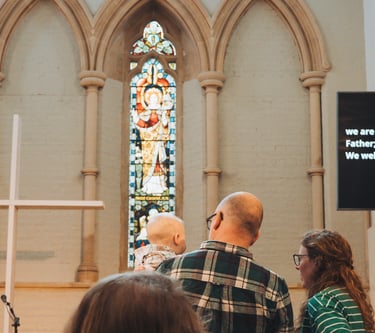
In 1897, land was given by St John’s College and the foundation stone laid to build the Institute alongside the east end of St Barnabas church. This was used to house the many groups of all ages that met during the week and on Sundays under the church’s care. Around this time pine pews gradually replaced the rush seats and an organ was installed. The stained glass window at the east end of the church was dedicated in 1912 and the First World War memorial consists of two stained glass windows and stone tablet at the west end of the church (1920). In 1922 PCC was set up to assist clergy in “parochial and spiritual ministrations” and in 1926 a freewill offering scheme was set up. The Electoral Roll was 400. Miss Elsie Barrett who some will remember in 1980’s, mused that “St Barnabas in the ‘20s was a nice little evangelical church with a moderate congregation. There were lots of families and neighbours knew each other.” During the 1930’s electric light was installed and a programme of redecoration and renovation undertaken. Stencil work, to the design of Prof EE Richardson was applied to the walls. Appeals for money had generous response from church in Kenya, S Africa, Greece and Singapore as well as locals. During World War 2 the nearest bomb fell on Donkey Common, the area now occupied by the Kelsey Kerridge Sports Hall and the Swimming Pool.
The School
In 1903 the school role stated that there were 167 girls aged 8 – 12 years and 108 boys and girls in the infants. Overspill classes took place in the Covent Garden Hall, which had been built on land given by Gonville and Caius College. By 1959 there were just 30 pupils and the building was declared unfit for purpose so the school was closed. Derek Wilkin has stories to tell about his time there.
The Workhouse
This was opened in a building opposite St Barnabas in 1838. Records show little contact between the church and its poorest parishioners. The workhouse was closed around 1935 and the building became a hospital during World War 2, and then the Mill Road Maternity Hospital until around 1984 when it moved to its present site at The Rosie. The City Council then undertook a huge refurbishment program and some imaginative rented, sheltered and very sheltered accommodation was built around three courtyard gardens, in the style of the existing Mill Road houses. This complex is called Ditchburn Place, Ditchburn being the name of the last master of the workhouse.
The Mosque was opened in Mawson Road in the 1980’s. This building may have been a synagogue in the past, and latterly the warehouse for the Co-op.
The Mill Road Library, opened in the 1897, was closed in the 1990’s. It is now the Indian Community and Cultural Association. A Hindu shrine will be installed in late 2007.
Since 1945
The Rev Ted Rushton and his wife served faithfully at St Barnabas for 38 years after returning from serving with BCMS in Burma. The concern for mission overseas continued, as encouraged by Rev C Butler in 1889, with some going overseas and Ted’s interest. However house prices rose, young families could no longer afford to live in the area, the age of the congregation rose and numbers fell away. The work of several organisations continued, notably The Boys Brigade which was captained by Derek Wilkin (a member of the congregation) until it closed down in the 1980’s.
The area became more cosmopolitan. Houses became accommodation for the Cambridge College of Arts and Technology and language schools.
Dennis Lennon with Sonja moved to St Barnabas as priest-in-charge in 1977 when the church was at a low level. So much so that the bishop said he would close the church unless it was revived. From the moment Dennis arrived much happened. Dennis had a wide range of gifts. He had a huge heart, a clear mind and a way with words that carried his hearers along. He expounded the truth “I believe teaching and expounding of the scripture to be a central part of my work here”, with fervour, enormous imagination and a twinkle. He widened the style of worship, initiated tea and coffee after services, home groups, had a special role of responsibility for the increasing number of students at Cambridge College of Arts and Technology (now Anglia Ruskin University) and started the outreach to international students with the Thursday evening coffee bar meeting in the Barn, as well seeing the re-birth of Sunday School as Highway and the flourishing of work with young people, young mums and the elderly. He could not oversee all this. Chris Butt, who was appointed curate at St B’s in 1978 with a particular role to open up Christian work at CCAT, was international co-ordinator for one year in 1977. Dennis was convinced that the best way to minister to students was to have a lively parish church to come along to. Many lived in or near the parish. They felt welcomed and contributed much to the life of the church. The vision to help different generations and church groups to work together and understand each other was at the heart of home groups. There was a well organised team visiting the elderly and frail in the parish. Lay ministry was hugely encouraged and could be seen with involvement in home groups, Christian graffiti, drama, choir, music group, pray-ers, parish mission. Brass Tacks (a precursor of Alpha?) was held regularly when any could come and a small group would explore the Christian faith and ask any questions.
In the centenary booklet Dennis said “What I hope we as a church are doing, is giving Christians the strength and power to live to Christ in spiritually demanding places. As we open ourselves to God’s word and expose the secular in our thinking and lives, so we move on in our obedience and maturity in Christ. I preach in order that Christians may think and act like believers, seeing themselves and the world from an eternal perspective.” For the 80’s he envisioned, “I want to see Christians equipped to serve the Lord where-ever He calls them and to be ready and able to make disciples, a new concern for missionary work overseas, a community of people with one mind and one vision, yet allowing the freedom for many different approaches and ideas to be held and tried out, above all to be equipping Christians to be practical believers each day in their work, home and in the community around us. I pray that St Barnabas will become increasingly relevant to the area, an indigenous church whose members make a steady Christian impact upon the parish as we open ourselves to serving Christ and His Kingdom here in Cambridge.”
1980’s onwards. The work has continued ...
Chris and Tricia Butt left to work in Hong Kong in 1982 for a number of years and then returned to UK. Chris and Tricia’s eldest daughter has been actively involved with St Barnabas as a student until summer 2007. Dennis and Sonja moved to St Thomas, Corstorphine, Edinburgh in 1983 where he was involved in two church plants. He was then appointed Diocesan Director of Evangelism in the Diocese of Sheffield in 1991 until his retirement in 1996. Douglas Holt was appointed curate in late 1982 and became priest-in-charge in April 1984. During Douglas’ ministry the position of Vicar was re-established. “Every member ministry” and “eschatological tension” are two phrases from that era. Michael with Debbie Becket was appointed curate in 1988 and he moved to become Vicar of St Paul’s (and hence our patron) in 1993. Leonard Browne with Alison and family arrived in 1992. He was vicar here until 2000. Possibilities for outreach into the community had been identified in a survey carried out by the St Barnabas Community Worker in 1989, and in autumn 1992 Archie Ferguson was appointed community worker (voluntary). Many projects were undertaken and individual participation encouraged – Brunch Breaks, community lunches, business lunches, services and Alpha at Highpoint prison, helping at Jimmy’s Nightshelter and The Bus Project. Liz Smyth was appointed curate in 1992, again with responsibility to the students at the now Polytechnic soon to be university, and all students. After 4 years Liz left to be married and Gavin Collins arrived with Christina and family. Gavin had a great interest in overseas mission and the Mission Support Group was set up during his time. This sub-group of the PCC continues with the vision of enabling and supporting present church members here at St B’s in their support of church members serving elsewhere, mostly abroad. Gavin and Christiana moved to Christ Church, Chorley Wood in 2002. Leonard and Alison Browne moved to Dean Close School in 2000 and we welcomed Nick and Anne Ladd in 2001. Colin and Natalie Brookes were with us from 2002 – 06 and Jon and Helen Scamman joined us in the new post of Associate Vicar in January 2007.
Notes on History of St Barnabas
1. 1862 Cottage meeting starts in Covent Garden – mission outreach to developing Mill Road, known as Sturton Town a development of rural Barnwell, from St Pauls Church. Originally part of the parish of St Andrew the Less the parishes of St Paul’s (1842) Priory Church (1854) St Matthews (1866) St Barnabas (1870) St Luke’s (1874) were created.
2. 1867 May Appeal launched for funds to build a church by Vicar of St Paul’s. Gonville and Caius College gave land and money to build first stage of church. “University is committed to participating in Christian work throughout land”
3. 1869 June 10 Foundation stone for chancel laid by Bishop of Ely. Population estimate 600 – 800
4. 1870 June 11 Chancel opened by Vicar of St Paul’s. Could seat 200 people
5. 1877 November 12 Appeal for church extension launched at the Guildhall – for nave, aisles and bell tower (never built)
6. 1877 Infant School built alongside St Barnabas by Governors of the Old Schools. Sunday School of 150 children. Artisan population included many men who worked on the railway, small shop owners, university bedders and servants.
7.1878 October 26 Memorial stone laid by Rt Hon Earl of Harwicke for church extension. Locals collected £1,800 for building project. Population estimate 2,000. Majority of funds given by outsiders including donations from every college, academics, older city churches of Little St mary’s, Great St Mary’s, St Giles, St Paul’s.
8. 1880 May 4. Consecration of St Barnabas by Bishop of Ely. Up to now services were taken by clergy from St Paul’s.
9. 1886 February 16. Guildhall Appeal for further enlargement of the church and formation of an Ecclesiastical District. Parish to be formed out of parts of St Paul’s, St Matthew’s and Christ Church (St Andrew the Less). This would only be granted if building was able to accommodate at least 500 people.
10. 1888 December 17. Ecclesiastical District confirmed by her Majesty’s Privy Council. Curate-in-charge at St Barnabas.
11. 1889 June. Foundation stone for St Philip’s laid by Professor Babington. Rapid growth of Romsey Town. Temporary wooden church of St Philip’s – mission outreach from St Barnabas. Curate at St Barnabas became vicar. Congregation urged to rely on themselves, not on outsiders, for any ministry and work.
12. 1890 March 13. Site given by Gonville and Caius for parsonage house. Area regarded as a slum.
13. 1890 May 1. St Philip’s opened and dedicated by Bishop of Ely with capacity of 500 seats. Population estimate 6,000. Church organ installed. Mission Hall in Cockburn Street
14. 1894 June Vicarage opened and dedicated by Rev HCG Moule, Principal of Ridley Hall.
15. 1897 May 6. Queen Victoria’s Diamond Jubilee. Total building programme costs £11,395 (£10,000 given from outside). St Barnabas the second largest parish in the Diocese of Ely. Foundation stone of Babington Memorial Institute (now known as The Barn) laid by Master of St John’s College to help accommodate the many groups meeting at the church on Sundays and during the week. St Johns’ College had given the land for this. Around 1900 pine pews started to replace rush chairs.
16. 1902 June 11. St Philip’s consecrated as independent Ecclesiastical District by Bishop of Ely.
17. 1906 November 8. Covent Garden Hall opened by Vice Chancellor of University.
18. 1907 – 08 Land purchased from Gonville and Caius College adjoining Covent Carden Hall, releasing the Drill Hall to become Infant’s School overspill during the week. St Barnabas Church of England school for girls aged 8 – 12 years and mixed infants 5 – 8 years. In 1903 167 girls and 108 infants enrolled. School continue until declared unfit for school purposes in 1959 when there were just 30 pupils.
19. 1912 June 11. East window unveiled by Bishop of Ely.
20. 1914. July . Water’s Almshouses opened administered by St Barnabas and St Philips jointly, then in 1980’s by St Philip’s alone, now independent.
21. 1920. Two lights in west window and tablet erected as First World War memorial.
22. 1922. PCC set up to assist clergy in parochial and spiritual ministrations
1926 Freewill offering scheme set up. Electoral Roll 400. Miss Elsie Barrett who some will remember in 1980’s, mused that “St Barnabas in the ‘20s was a nice little evangelical church with a moderate congregation. There were lots of families and neighbours knew each other.”
1930’s Electric light installed. Programme of redecoration and renovation. Stencil work, to the design of Prof EE Richardson applied to the walls. Appeals for money had generous response from church in Kenya, S Africa, Greece and Singapore as well as locals.
More historical details can be read in an extract from the centenary booklet.

|
| Service times |
|
9.00am
10.30am
7.00pm
more...
|
Sermon audio  |
|

|
Sermons are available online
listen... |
| Alpha in St Barnabas |
|
Looking for answers?
The Alpha course is an opportunity for anyone to explore the
Christian faith.
more...
|
 |
Members' area  |
Members' area.
go...
|
|